

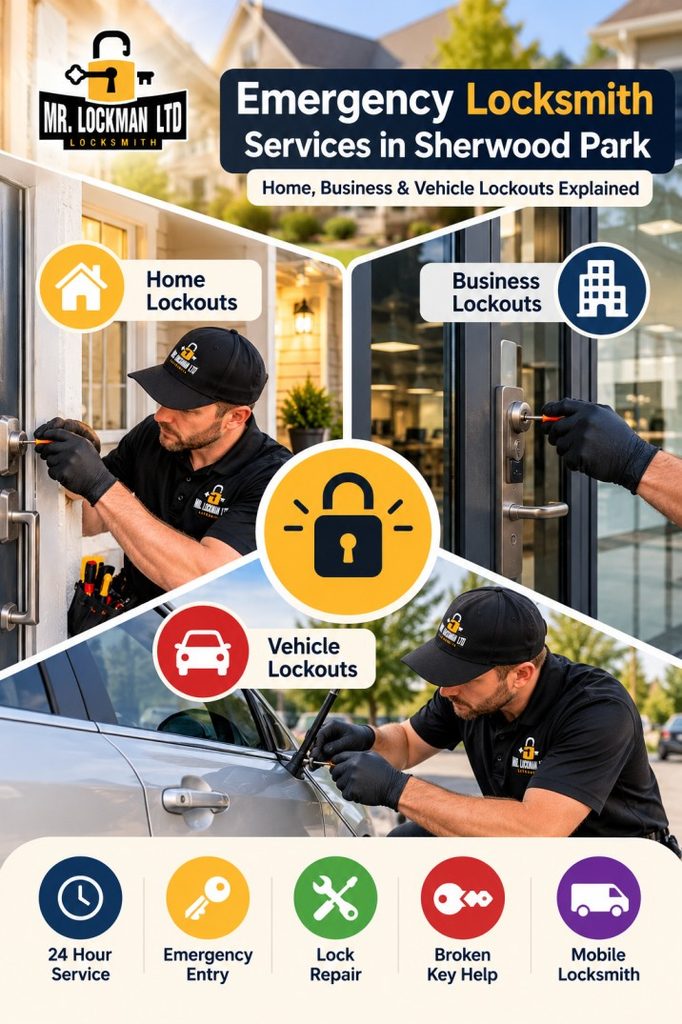
Getting locked out of your home, business, or vehicle can happen without warning. You might step outside to collect a delivery and realise your keys are inside, discover that your key has snapped in the lock, or find that your car door will not unlock when you need to leave for work. In these situations, knowing when to call an emergency locksmith in Sherwood Park can save time, reduce stress, and help prevent unnecessary damage.
Lock-related emergencies are not always simple lockouts. A damaged deadbolt, a key that will not turn, a faulty electronic lock, or a broken vehicle key can also leave a property or vehicle inaccessible. The right solution depends on the type of lock, the cause of the problem, and whether the situation creates an immediate security risk.
This guide explains how emergency locksmith services in Sherwood Park can help with residential, commercial, and automotive emergencies. It also covers what to do before a locksmith arrives, how to assess the situation safely, and which mistakes to avoid when you are locked out.
Whether you are dealing with a house lockout, a car lockout, or a damaged business lock, understanding your options can help you make a more informed decision.
An emergency locksmith helps resolve urgent problems involving locks, keys, doors, and access systems. Unlike routine locksmith work, emergency callouts usually involve a situation that cannot reasonably wait for a standard appointment.
An Emergency Locksmith may assist with:
The exact services available depend on the locksmith’s training, equipment, and vehicle inventory.
For example, a front door that will not open because a key has broken inside the cylinder requires a different approach from a door that has swollen in cold weather and no longer aligns with its frame. Similarly, a modern vehicle with an electronic locking system may need specialist diagnostic equipment rather than traditional lock-picking tools.
A qualified locksmith should assess the cause before deciding on a repair or entry method. This helps avoid unnecessary damage and ensures that the underlying problem is not overlooked.
Consider an emergency callout when you cannot secure your property, cannot access essential belongings, or face a genuine safety or security concern.
Examples include:
If someone is in immediate danger, a child or vulnerable person is trapped, or a pet is in a dangerously hot vehicle, contact emergency services first. Do not wait for a routine locksmith appointment when there is an immediate threat to life or safety.
A home lockout can happen even when you are careful with your keys. A door may close behind you, a key may go missing during a busy morning, or an older lock may suddenly stop responding.
In these situations, residential locksmith services in Sherwood Park can help restore access while protecting the door, frame, and existing hardware wherever possible.
If you find yourself locked out of your house, take a moment to assess the situation before trying to force the door.
A common example is a homeowner who discovers that the key turns slightly but the deadbolt does not retract. The problem may involve the lock cylinder, bolt alignment, or pressure on the door. Applying more force may make the problem worse.
A locksmith can assess the mechanism and select an appropriate entry method based on the lock and door construction.
The aim of professional emergency entry is to restore authorised access with the least practical disruption.
Depending on the circumstances, a locksmith may use specialist non-destructive techniques. However, no method is guaranteed to work on every lock, and certain damaged or high-security mechanisms may require drilling or component replacement.
Before work begins, ask the locksmith:
These questions are especially useful if the door has a high-security deadbolt, a multipoint locking system, or an electronic access mechanism.
After entry, check that the lock operates smoothly from both sides, where appropriate, and that the door closes and latches correctly. Getting inside is only part of the solution if the lock still cannot secure the property.
A business lockout can disrupt opening hours, delay employees, affect customer appointments, and create problems for deliveries. The impact can be greater when a shop, office, warehouse, or commercial unit cannot be secured at the end of the day.
Commercial doors may also have more complex hardware than standard residential doors, including panic hardware, access-control systems, restricted key systems, and commercial-grade deadbolts.
Commercial access problems can result from several issues:
The appropriate response depends on the business’s security procedures and the type of locking system installed.
For example, if a retail shop cannot lock its entrance after closing, the immediate priority is not simply replacing a key. The business needs to restore a secure barrier against unauthorised entry. Temporary measures should be discussed with the locksmith and, where relevant, the property manager or security provider.
To make an emergency visit more efficient, provide the locksmith with the following information:
For leased commercial premises, contact the property manager if the lease or building policy requires approval for changes to the locks.
Following a lost-key incident, businesses should also consider whether the missing key could identify the premises or provide access to sensitive areas. Depending on the risk, rekeying or replacing the affected locks may be more appropriate than simply making another key.
A vehicle lockout can be particularly inconvenient when it happens in a car park, at work, during a shopping trip, or in poor weather. It may also create a safety concern if essential medication or a child’s belongings are inside.
Automotive locksmith services in Sherwood Park may help with vehicle entry and certain key-related problems, depending on the vehicle make, model, year, and security system.
If your keys are locked inside your vehicle, follow these steps before attempting to gain access.
First, check your surroundings. Move to a well-lit, safe location if you are in a car park or on a roadside. Avoid standing in traffic or working around moving vehicles.
Second, check for an authorised alternative. A spare key or assistance from another authorised driver may resolve the issue without specialist work.
Third, identify the vehicle accurately. Make a note of the make, model, approximate year, and location. These details help the locksmith determine whether specialist tools or equipment may be needed.
Fourth, avoid improvised entry tools. Metal rods, coat hangers, and wedges can damage weather seals, wiring, airbags, paintwork, or internal locking components. Modern vehicles often have sensitive door and electronic systems.
Finally, request professional assistance. Ask whether the locksmith can service your particular vehicle and whether the quoted price covers the required entry method.
If a child, vulnerable person, or animal is trapped in a hot vehicle, contact emergency services immediately rather than waiting for a locksmith.
A broken key can cause problems even when the vehicle itself is functioning normally. The key may snap while turning, the blade may become worn, or the remote may stop working.
These situations require different assessments.
Do not keep twisting a damaged key or try to extract a fragment with sharp household tools. You could push the fragment deeper or damage the cylinder.
When requesting help, explain whether the key physically broke, the remote stopped responding, or the vehicle failed to recognise the key. This distinction helps the locksmith prepare for the correct type of work.
Sometimes, the door opens, but the lock remains unreliable. This is an important distinction because gaining access does not necessarily resolve the original security problem.
A damaged lock may have worn internal components, a bent key, a loose cylinder, misaligned hardware, or damage caused by attempted forced entry.
Look for these symptoms:
A key that suddenly becomes difficult to turn does not automatically mean the entire lock must be replaced. The issue could involve door alignment, worn components, or the key itself.
However, repeated failure should not be ignored. A lock that works intermittently can fail at an inconvenient time.
Door lock repair may be appropriate when the existing hardware is fundamentally sound, and the fault can be corrected safely.
For example, a loose mounting screw or minor alignment issue may be repairable without replacing the complete lock. A severely damaged cylinder, compromised locking mechanism, or lock affected by a break-in may require replacement instead.
The decision should consider:
After a break-in, cosmetic repairs alone may not be sufficient. The locksmith should inspect the affected locking points and explain whether the hardware remains secure.
Lock emergencies do not always happen during standard business hours. A key may break late at night, a lock may fail early in the morning, or a business may discover a security problem after closing.
A 24 hour locksmith may offer assistance outside normal working hours, but availability and response times vary. It is important to confirm that the provider actually offers emergency callouts for your type of problem.
Before agreeing to the work, clarify the following points.
Is the service available now? Ask whether the locksmith is currently taking emergency calls and whether the estimated arrival time is realistic.
What is the callout fee? Confirm whether a separate attendance charge applies before any work begins.
What is included in the estimate? Ask whether labour, replacement parts, specialist tools, after-hours charges, and applicable taxes are included.
Can the locksmith handle your specific lock? Electronic locks, high-security cylinders, commercial access systems, and modern vehicle keys may require specialist capabilities.
Will you receive a final quote before work begins? A reliable provider should explain the expected cost and obtain your agreement before proceeding, subject to any clearly explained limitations.
Can the locksmith verify the work? Ask how the lock will be tested after entry, repair, or replacement.
These checks can help you avoid unexpected charges and reduce the chance of hiring someone who arrives without the necessary equipment.
A Mobile Locksmith travels to the location of the problem with tools, equipment, and, where available, replacement parts.
This can be useful when you cannot safely move the vehicle, when a property cannot be secured, or when the lock requires an on-site assessment.
However, a mobile service may not carry every replacement component. Unusual locks, specialist electronic systems, or uncommon vehicle keys may require parts to be ordered or additional work at a workshop.
When arranging a visit, describe the problem clearly rather than saying only that the lock is not working. Mentioning the lock type, key condition, and any visible damage can help the provider determine what to bring.
An after-hours locksmith can be useful when a lock problem occurs outside regular business hours. However, your immediate safety should guide your next step, especially if you are alone, stranded, or dealing with a damaged entrance.
If you are locked out of your home at night, wait in a well-lit public area or with a trusted neighbour if possible. Avoid remaining in an isolated location simply because the locksmith is expected to arrive soon.
If your business entrance has been damaged, follow your security procedures and avoid confronting anyone suspected of causing the damage. Contact the police if you believe a crime has occurred or there is an immediate threat.
For vehicle lockouts, remain somewhere safe and avoid standing beside moving traffic. If weather conditions are severe, seek shelter where practical.
When the locksmith arrives, verify their identity and confirm the agreed work before allowing them to proceed. Be prepared to demonstrate that you are authorised to access the property or vehicle.
A stolen key creates a different problem from a key that has simply been misplaced.
If the key can be linked to your address or business, someone may be able to use it to gain unauthorised access. The appropriate response depends on the type of key and the likelihood that it could be misused.
Possible options include:
For a business, this may also require updating key records and notifying the person responsible for premises security.
Do not assume that making a spare key solves the risk associated with a stolen one. The central question is whether the original key can still provide access.
When you are in a hurry, it is tempting to try the quickest solution available. Unfortunately, some improvised methods can turn a minor inconvenience into an expensive repair.
Applying excessive force to a key can snap it inside the cylinder or damage internal components. If the key does not turn normally, stop and seek an assessment rather than repeatedly twisting it.
Improvised tools can scratch surfaces, damage seals, bend hardware, or interfere with vehicle electronics. They may also create a security risk if used incorrectly.
An advertised starting price may not include labour, replacement parts, travel, or after-hours charges. Ask for a breakdown of expected costs before authorising work.
If the locksmith discovers an unexpected complication, request a revised estimate and agree on the next step before additional work begins.
Not every faulty lock needs complete replacement. A repair, adjustment, or rekeying may be sufficient, depending on the condition of the hardware and the security risk.
Ask the locksmith to explain the reason for the recommended solution and whether a less extensive option is suitable.
A door that repeatedly jams may have an alignment issue. A key that keeps breaking may indicate wear or an underlying problem with the cylinder.
Treating only the immediate symptom can lead to another emergency. Ask what caused the failure and whether any preventive repair is recommended.
Preventing every lockout is impossible, but a few practical habits can reduce the likelihood of repeat problems.
Keep a secure spare key
Give a spare to a trusted person or use a secure key-storage arrangement. Avoid hiding a key in obvious places such as under a doormat or flowerpot.
Address early signs of wear
A key that sticks, a loose handle, or a bolt that scrapes should be inspected before the mechanism fails.
Review key security
If keys are lost or stolen, consider whether rekeying or changing access permissions is necessary. Keep track of who holds keys to your home or business.
Save emergency contact details
Research a reputable locksmith before an emergency happens. Keep the contact information accessible without relying solely on a phone that may be locked inside your vehicle or property.
For homes in Sherwood Park, seasonal temperature changes can also affect door alignment and the operation of some locking mechanisms. If a door becomes difficult to close during colder weather, have the cause assessed rather than repeatedly forcing the deadbolt.
Businesses can reduce disruption by maintaining authorised spare keys, documenting access permissions, and arranging periodic checks of heavily used entrances.
Vehicle owners should consider keeping a spare key in a secure location and replacing a visibly damaged key before it breaks completely.
Understanding the normal process can make an emergency callout less stressful.
A professional visit generally involves several steps, although the exact procedure depends on the problem.
Step 1: Initial assessment. The locksmith asks about the lock, the symptoms, and the circumstances of the lockout.
Step 2: Identity and authorisation checks. The locksmith may request identification, proof of residence, business authorisation, or vehicle documentation. If documents are inaccessible because they are locked inside, explain the situation and ask what alternative verification is acceptable.
Step 3: Explanation of the proposed work. The locksmith explains the recommended method, likely risks, and expected costs before proceeding.
Step 4: Entry, repair, or replacement. The work is carried out using a method appropriate for the lock and circumstances.
Step 5: Testing and handover. The locksmith checks the operation of the affected lock and explains any remaining limitations or recommended repairs.
For example, if a locksmith opens a house door after a failed deadbolt, the job should not end with access alone if the bolt remains unable to engage securely. The cause should be identified, and you should understand whether a temporary measure or a permanent repair is needed.
Similarly, after automotive entry, the vehicle’s doors should be checked for normal operation, and any damaged key or electronic issue should be discussed separately from the entry itself.
A clear explanation of the work performed helps you understand what has been resolved and what still requires attention.
Choosing a locksmith during an emergency requires balancing response time, technical capability, transparency, and security.
A nearby provider may be able to arrive quickly, but proximity alone does not guarantee the right expertise. A locksmith experienced with residential deadbolts may not have the equipment needed to program a modern vehicle key or service a complex commercial access system.
When evaluating a provider such as Mr. Lockman Ltd, focus on the practical questions that matter during an emergency.
It is sensible to compare these factors before you need emergency assistance. If you are already locked out, a short conversation covering the problem, likely costs, and expected arrival time can still help you make a better-informed choice.
A lockout can disrupt your day, but understanding the right response can help you regain access without creating additional damage or security risks. Whether you are facing a house lockout, a commercial entrance that will not secure, a car lockout, or a broken key, the priority is to assess the situation and choose an appropriate solution.
The most effective emergency locksmith services in Sherwood Park focus on more than simply opening a door. They address the underlying fault, explain the available options, provide transparent pricing, and check that the affected lock works correctly after the job is complete.
For homeowners, business operators, and vehicle owners, preventive maintenance and secure spare-key arrangements can reduce the likelihood of future emergencies. When urgent assistance is necessary, Mr. Lockman Ltd can be considered as a provider to evaluate based on its relevant services, availability, pricing transparency, and ability to handle your specific locksmith problem. Confirm these details directly before booking.
Arrival time depends on the locksmith’s current workload, location, traffic, weather, and the complexity of the job. An urgent callout may be possible relatively quickly, but no particular arrival time should be assumed without confirmation.
When calling an emergency locksmith in Sherwood Park, explain whether you are locked out of a home, business, or vehicle and whether there is an immediate safety or security concern. Ask for an estimated arrival time and confirm whether that estimate includes travel to your specific location.
If the situation involves an immediate threat to life, contact emergency services rather than relying on a locksmith’s estimated arrival.
In many cases, a locksmith can attempt non-destructive entry, but success depends on the lock design, its condition, and the reason the door will not open.
A functioning lock with the correct key trapped inside the house may present a different challenge from a damaged deadbolt or a high-security cylinder. Some mechanisms cannot be opened using non-destructive techniques, making replacement necessary.
Before work begins, ask which method is likely to be used and whether damage is a possibility. A responsible locksmith should explain the options and obtain your agreement before proceeding with the proposed work.
First, check whether you have access to a spare key or can contact another authorised driver. Avoid forcing the door or using improvised tools that could damage the vehicle’s paint, seals, wiring, or locking system.
If you cannot regain access safely, contact a locksmith who handles your vehicle’s make, model, and year. Explain whether the key is inside the vehicle, the remote is malfunctioning, or the key is damaged.
If a child, vulnerable person, or animal is trapped in a hot vehicle, contact emergency services immediately. Do not wait for a standard locksmith callout.
The correct choice depends on the cause and severity of the fault. Minor alignment problems or certain loose components may be repairable, while a severely damaged cylinder or a lock compromised by forced entry may require replacement.
A locksmith should inspect the hardware and explain the available options. Consider the cost of repair, the age of the lock, the availability of replacement parts, and whether the existing hardware provides adequate security.
If a key has been stolen, ask whether rekeying or replacing the lock is necessary. Repairing a mechanical fault alone will not prevent an unauthorised person from using a stolen key that still works.
Before calling a 24 hour locksmith, identify the affected property or vehicle, describe the symptoms, and explain whether the door is locked shut, the key is broken, or the lock cannot secure the entrance.
Ask about the callout fee, estimated arrival time, likely labour costs, replacement parts, and applicable after-hours charges. Confirm that the locksmith can work on your specific lock or vehicle.
Keep identification and any available proof of authorisation ready. If these documents are locked inside, tell the locksmith and ask what alternative verification is acceptable.
These preparations help the locksmith assess the situation and can reduce delays caused by missing information or unsuitable equipment.