


Getting locked out of your vehicle can happen when you least expect it. You might leave your keys on the driver’s seat while unloading groceries, accidentally lock the doors while the engine is running, or discover that your key fob has stopped working in a parking lot. In these situations, knowing what to do next can save time, reduce stress, and help prevent unnecessary damage to your vehicle.
If you experience a car lockout in Leduc, the first step is to stay calm and assess the situation. Before attempting to unlock the vehicle yourself or contacting a locksmith, check whether the keys are genuinely inaccessible, whether another entry method is available, and whether you are parked somewhere safe.
Leduc drivers may face lockouts in residential driveways, shopping centre parking lots, workplace car parks, or roadside locations. Each situation requires a slightly different response, especially when children, pets, extreme temperatures, or traffic are involved.
This guide explains how to experience a Car Lockout more confidently by following practical safety steps, understanding when professional assistance is necessary, and avoiding common mistakes that can turn a simple inconvenience into an expensive repair.
Whether you have a locked car, lost keys, a broken key, or a malfunctioning remote, these recommendations will help you decide what to do before calling a car locksmith in Leduc.
A car lockout occurs when you cannot access your vehicle using the available keys, remote, or normal unlocking methods. Although some situations are straightforward, others involve mechanical faults, electronic security systems, or damaged keys.
Understanding the cause helps you explain the problem accurately when requesting assistance.
Common causes include:
For example, imagine you stop at a local shop, place your keys on the passenger seat, and close the door. If the vehicle locks automatically, you may need professional vehicle entry assistance. However, if only the remote has failed, an available mechanical key or manufacturer-recommended backup procedure may solve the problem without specialist entry work.
The important point is to identify what happened rather than immediately assuming that the entire locking system has failed.
When you discover that your keys are inside a locked vehicle, avoid rushing into action. A few simple checks can help you determine whether you can resolve the issue safely or need professional support.
Before focusing on the lock, look at where the vehicle is parked.
If you are in a busy car park, near moving traffic, or on the roadside, move to a safe location where possible. Keep away from passing vehicles and avoid standing behind or beside a vehicle in an area with poor visibility.
If the lockout happens late at night, choose a well-lit area and let someone you trust know where you are. If you are stranded in a dangerous location, prioritise safety and contact appropriate roadside assistance or emergency services when necessary.
Check the visible areas of the vehicle before arranging help.
Look through the windows for keys on the driver’s seat, passenger seat, dashboard, or centre console. If your vehicle has a separate boot, determine whether the keys might be inside it.
If you have a connected vehicle app, check whether it offers remote unlocking. Only use an account and access method you are authorised to use.
Avoid repeatedly pressing buttons on the remote if it appears unresponsive. Instead, check the manufacturer’s instructions for the appropriate backup method.
Some vehicles have a hidden mechanical key inside the remote fob. Others provide a designated mechanical keyhole or a manufacturer-supported emergency unlocking procedure.
Consult your owner’s manual if you have access to it digitally or through another source.
Do not assume that every vehicle has the same backup system. Modern vehicles can have different locking mechanisms, and an incorrect attempt may damage trim, seals, wiring, or electronic components.
If the keys are inaccessible, the lock is damaged, or the vehicle’s security system is not responding, professional assistance is usually the safer option.
An emergency locksmith in Leduc may be able to assess the situation, verify your authority to access the vehicle, and determine an appropriate entry method.
When explaining the problem, provide the vehicle’s make, model, approximate year, location, and a brief description of what happened. These details help the locksmith prepare suitable equipment before travelling to you.
A mobile service can be particularly useful when your vehicle is parked away from home, your keys are inaccessible, or arranging a tow would be inconvenient.
A mobile locksmith travels to the vehicle rather than requiring you to bring the car to a workshop for an initial assessment.
Depending on the technician’s qualifications, equipment, and vehicle compatibility, mobile services may include:
Not every locksmith offers every service, and not every vehicle can be unlocked or rekeyed using the same tools. Newer vehicles may use encrypted transponders, proximity systems, or other security features that require compatible diagnostic equipment.
When contacting a mobile service, prepare the following information:
For instance, telling the technician that your remote stopped working after a battery warning appeared is more useful than simply saying that the car will not open. It helps distinguish a potential remote issue from a conventional lockout.
Not all lockouts require the same equipment or level of expertise. Choosing a suitable technician can reduce the risk of vehicle damage and unnecessary expense.
If you need a car locksmith in Leduc, focus on capability, transparency, and safe working practices rather than selecting the first available number without checking the details.
Provide the exact make, model, and year. Some vehicles have more complex security systems than others, and a locksmith may need specific tools or software to work on them.
Ask whether the technician regularly handles your type of vehicle and whether the requested service is within their capabilities.
Before agreeing to the work, ask for a breakdown of the likely charges.
Clarify whether the quoted amount includes:
A straightforward lockout may cost less than a replacement key that needs cutting and electronic programming. The final price can depend on the vehicle, the time of day, the complexity of the fault, and the parts required.
Request confirmation of any change in price before additional work begins.
A reputable professional should be prepared to explain their identity, the work they intend to perform, and any proof of vehicle ownership or authority they require.
Keep your registration, identification, or other relevant documents available if requested. Requirements vary according to the situation, but vehicle security should not be bypassed without appropriate authorisation.
Before work starts, ask how the technician intends to access the vehicle and whether a non-destructive approach is suitable.
Professional entry methods depend on the door design, lock type, vehicle security system, and condition of the mechanism. No responsible technician should promise that every lockout can be resolved using one universal technique.
A lockout caused by a key left inside the vehicle differs from one involving a missing or damaged key. Identifying the problem early helps you request the correct service.
If you can see the key inside the vehicle, do not try to force a window or pry open the door.
Check whether an authorised remote-unlocking app or an approved spare key is available. If neither option works, arrange professional vehicle entry.
This is often a relatively straightforward lockout, although vehicle design and locking conditions can affect the method and time required.
Losing every available key can involve more than unlocking the vehicle.
Depending on the vehicle, you may need a replacement key cut to match the lock, a programmed transponder, a compatible remote, or a proximity key configured to communicate with the car.
Before authorising replacement, ask whether the technician can supply and program the required key for your exact model. Some vehicles require dealer-level procedures or additional security verification.
If you suspect your keys were stolen rather than misplaced, ask whether the vehicle’s security system supports disabling the missing key. This can help reduce the risk of unauthorised access, although the available options vary by model.
A broken key can be especially frustrating because part of the key may remain lodged in the mechanism.
Do not push the fragment farther inside, insert another key against it, or apply glue. These actions may complicate extraction or damage the lock.
A technician can assess whether the fragment can be removed safely and whether the lock or key needs replacement. If the key broke because it was bent, worn, or difficult to turn, the underlying problem should also be investigated.
A non-responsive fob does not automatically mean you are dealing with a full lockout fault.
The battery may be depleted, the fob may be damaged, or the vehicle’s battery or receiver may have a problem. Follow the owner’s manual to locate the approved backup entry procedure and check whether the fob battery can be replaced safely.
If a new battery does not restore normal operation, professional diagnosis may be needed.
When drivers are locked out, the temptation to solve the problem with a coat hanger, screwdriver, plastic wedge, or improvised tool can be strong. Online videos may make these methods appear quick and simple, but modern vehicle doors are more complicated than they look.
Inside a door, there may be wiring, locking actuators, side-impact protection components, and other equipment that can be damaged by careless attempts.
Forcing the door open: Applying pressure to the door frame can bend metal, damage weather seals, or create wind noise and water leaks.
Prying near the window: An improvised tool can scratch the glass, damage trim, or interfere with internal mechanisms.
Breaking a window unnecessarily: Replacing glass can be expensive, and shattered glass creates a safety hazard. Window damage should not be a routine response to an ordinary lockout.
Trying random electronic procedures: Repeatedly operating unfamiliar controls or following instructions intended for another model can make diagnosis more difficult.
Using excessive force on a key: If a key will not turn, forcing it can break the key or damage the lock cylinder.
Ignoring the actual cause: If a door repeatedly locks with the keys inside, or the remote works inconsistently, simply gaining entry does not fix the underlying problem.
A professional may be able to resolve a routine lockout without damaging the vehicle. However, the appropriate technique depends on the particular vehicle and the circumstances.
A lockout becomes more complicated when the vehicle is parked in an exposed or hazardous location. In these circumstances, the first decision should be about personal safety rather than how quickly the doors can be opened.
If your vehicle is stopped on a shoulder or close to moving traffic, remain in a safe position and follow local roadside safety guidance. Do not stand in a live traffic lane or attempt repairs near passing vehicles.
Contact an appropriate roadside assistance provider if you need help securing the vehicle or managing the roadside situation. If there is an immediate danger, use emergency services.
Share your exact location, a nearby landmark, and the vehicle details with the service provider. Keep your phone charged if possible and stay somewhere safe while waiting.
Ask for an estimated arrival window and confirm that the technician has understood the location. In less accessible areas, weather, traffic, and technician availability can affect response times.
This situation requires a different response from an ordinary lockout.
If a child or pet is trapped inside a hot vehicle, showing signs of distress, or facing another immediate threat, call emergency services immediately. Do not wait for a routine locksmith appointment when health or safety may be at risk.
A professional lockout service may also be contacted, but emergency assistance takes priority when there is a credible risk of serious harm. The safest response depends on the urgency and the conditions inside the vehicle.
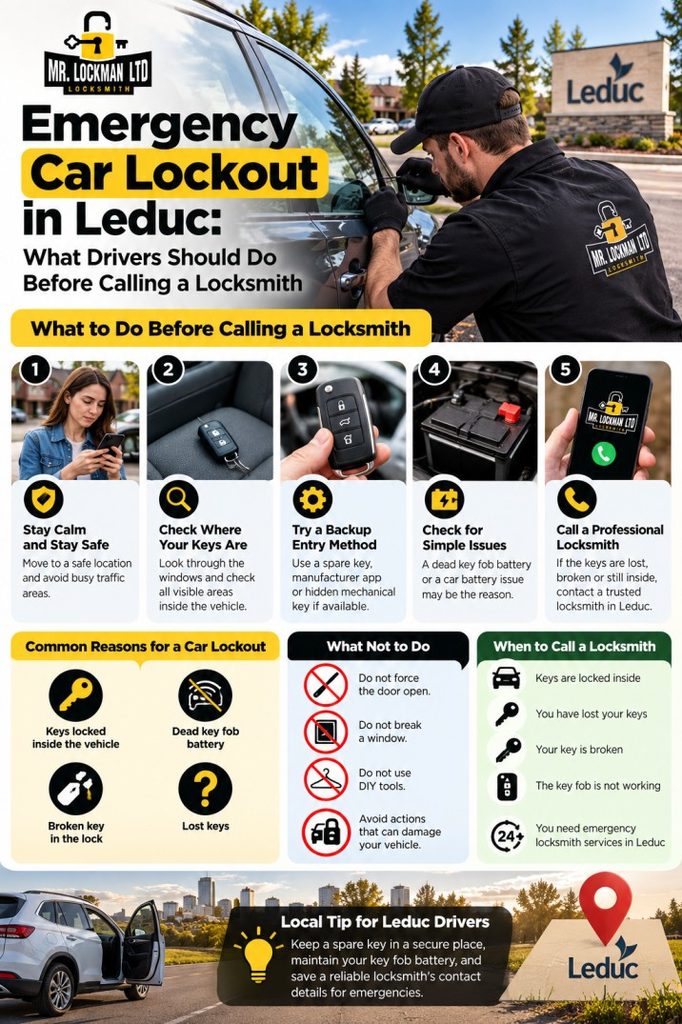
To experience a Car Lockout without unnecessary panic, it helps to understand how the right response changes with the situation. The following examples illustrate practical decisions drivers may face.
You return to your vehicle after shopping and discover that the doors are locked while your keys are visible on the driver’s seat.
First, check whether you have an authorised remote-unlocking option or a spare key nearby. If neither is available, contact a suitable mobile technician.
Tell the technician that the keys are inside and the vehicle is otherwise functioning normally. There may be no need for towing or key replacement if the only issue is entry.
Practical lesson: Explain the specific lockout rather than requesting a replacement key before the vehicle has been assessed.
You finish work and cannot find your keys. You have checked your pockets, bag, desk, and the surrounding parking area without success.
Before arranging assistance, consider whether a spare key is accessible and whether the keys might have been stolen. If no spare is available, ask about vehicle entry and replacement-key options.
If a new key must be programmed, the service may require proof of ownership and additional time. A replacement key may also be a separate charge from the initial entry service.
Practical lesson: Confirm whether you need entry only or a complete replacement-key solution.
You reach your vehicle on a cold day, press the remote button, and nothing happens.
The remote battery may be weak, but the vehicle’s own battery or locking system could also be responsible. Follow the owner’s manual to check for an approved mechanical key or backup procedure.
If the doors remain inaccessible, explain that the remote has stopped responding rather than assuming the key is locked inside.
Practical lesson: Describe the symptoms accurately so the technician can consider both mechanical and electronic causes.
You attempt to unlock your vehicle and the key snaps, leaving a fragment inside the lock.
Stop turning the remaining piece and avoid pushing the broken section farther into the mechanism. Contact a qualified professional who can assess extraction and replacement options.
If the key had been difficult to turn before breaking, mention this. The lock cylinder may have a separate fault that needs attention.
Practical lesson: Address the cause of the breakage, not just the immediate access problem.
These scenarios show why accurate information, safe decisions, and appropriate professional support can make a stressful situation easier to manage.
Mr. Lockman Ltd provides reliable locksmith services in Edmonton, including lock changes, lock repairs, emergency locksmith assistance, and residential and commercial security solutions tailored to your needs.
Although no driver can prevent every lockout, a few simple habits can reduce the likelihood of being stranded.
Where practical, keep a spare key at home or with a trusted person who can reach you when needed.
Avoid hiding a spare key in an obvious location on the vehicle. External hiding places can create a security risk and may not be suitable for modern vehicles.
If your vehicle uses a smart key or electronic transponder, verify that the spare is compatible and functional rather than assuming that an untested spare will work.
Read the owner’s manual to learn how your vehicle handles a dead remote battery, mechanical entry, and emergency access.
Some vehicles have a physical key concealed inside the fob. Others require specific procedures to access the door lock or start the vehicle when the remote battery is depleted.
Knowing these details before a problem occurs is more useful than trying to find instructions while standing outside a locked vehicle.
Look for signs of wear, cracks, loose buttons, or intermittent operation. Replace the remote battery according to the manufacturer’s instructions when necessary.
If a mechanical key becomes bent or difficult to turn, have it inspected instead of forcing it. Repeated resistance can indicate a worn key or a problem with the lock.
Before closing the door, make a habit of confirming that you have your keys with you.
This is especially useful when unloading shopping, refuelling, moving equipment, or placing items in the boot. If you use a remote-start feature, understand how your vehicle handles locking and key detection.
Keep the contact information for a suitable locksmith or roadside assistance provider somewhere accessible on your phone.
Before an emergency occurs, check the provider’s service area, vehicle compatibility, pricing transparency, and availability. Having these details ready can reduce the pressure to make a rushed decision.
A few preparations can help the technician work more efficiently and reduce misunderstandings about cost or the required service.
A useful rule is to separate vehicle entry from key replacement. Unlocking the door does not necessarily require replacing the key, while replacing a missing transponder key may involve several additional steps.
If you need automotive locksmith services in Leduc, explaining your circumstances accurately will help the provider determine which service is appropriate. Availability, response time, and the final cost should be confirmed directly rather than assumed.
A vehicle lockout can interrupt your day, but the right response can help you avoid unnecessary stress, damage, and expense. Start by checking your surroundings, confirming what happened to your keys, and looking for an authorised backup entry method. If those options do not work, seek professional assistance instead of experimenting with improvised tools.
For drivers dealing with a car lockout in Leduc, preparation makes a practical difference. Knowing your vehicle’s backup procedures, keeping a secure spare key, maintaining your remote, and saving reliable contact details can make future incidents easier to manage.
If you need a car locksmith in Leduc, explain the situation clearly, confirm the likely cost, and ask about the technician’s experience with your vehicle. When the problem involves missing keys, a broken key, or an electronic fault, make sure the provider can handle the specific work required.
Ultimately, learning how to experience a Car Lockout calmly means knowing when a simple check may solve the problem and when professional help is the safer choice. A measured response protects your vehicle, supports your personal safety, and helps you get back on the road with fewer complications.
Start by checking your surroundings and making sure you are safe. Determine whether your keys are inside the vehicle, missing, or not working. If available, try an authorised remote-unlocking app or the manufacturer’s approved backup entry method.
Avoid forcing the door or attempting to pry open a window. If you cannot regain access safely, contact a qualified professional and explain your vehicle details and exact location. If a child or pet is in immediate danger inside the vehicle, call emergency services without delay.
The time required depends on the vehicle’s locking system, the nature of the problem, the technician’s equipment, and the conditions at the scene.
A straightforward lockout may be resolved relatively quickly once the technician arrives. A damaged lock, broken key, electronic fault, or complex security system may require additional diagnosis.
Travel time is separate from the time needed to unlock the vehicle. When requesting assistance, ask for an estimated arrival window and whether the technician anticipates any complications with your particular model.
In many cases, a trained automotive locksmith can use an appropriate non-destructive entry method. However, the available options depend on the vehicle’s design, security features, and condition.
Modern vehicles may have sophisticated locking mechanisms and sensitive components inside their doors. An experienced technician should assess the situation before selecting a method and explain any relevant limitations.
No method can be guaranteed to work on every vehicle without damage. Avoid forcing doors, inserting improvised tools, or breaking glass as a routine response to a lockout.
First, determine whether you need immediate vehicle entry, a replacement key, or both. Contact a professional who can confirm whether they support your vehicle’s make, model, and year.
Depending on the vehicle, the solution may involve cutting a new mechanical key, supplying a compatible remote, programming a transponder, or configuring a proximity key. Some models require specialised equipment or dealer assistance.
Be prepared to provide proof of ownership or other required authorisation. Before approving the work, ask for an estimate that distinguishes entry charges from key cutting, replacement parts, and programming.
Contact a qualified professional when your keys are inaccessible, the lock is damaged, your key has broken, or the vehicle’s locking system is not responding and you cannot use an approved backup method.
Professional assistance is particularly appropriate when a DIY attempt could damage the door, window, lock cylinder, or electronic components. It can also be useful when all keys have been lost, and replacement or programming may be required.
However, a vehicle containing a child or pet in immediate danger is an emergency that should not be treated as a routine locksmith call. Contact emergency services immediately and follow their instructions.